

First Time in a Fancy Cafe Trend: The Table Joke Explained
The first time in a fancy cafe trend is a short comedy scene about misreading the furniture: a customer treats a small round table as a stool, then sees another customer use the nearby bench and realizes the mistake. The embarrassed attempt to move into the right seat is the payoff.
The caption makes the setting sound ordinary. The picture supplies the surprise. If you want to cast yourself and a friend in that scene, Fancy Cafe AI's two-photo generator provides a preset version. Understanding the sequence first makes it easier to judge whether your finished video tells the joke clearly.
What happens in the clip?
The essential relationship is between two pieces of furniture. A small tabletop looks just plausible enough as a seat; a low bench looks just unusual enough to overlook. The second customer reveals their intended uses without explaining anything.
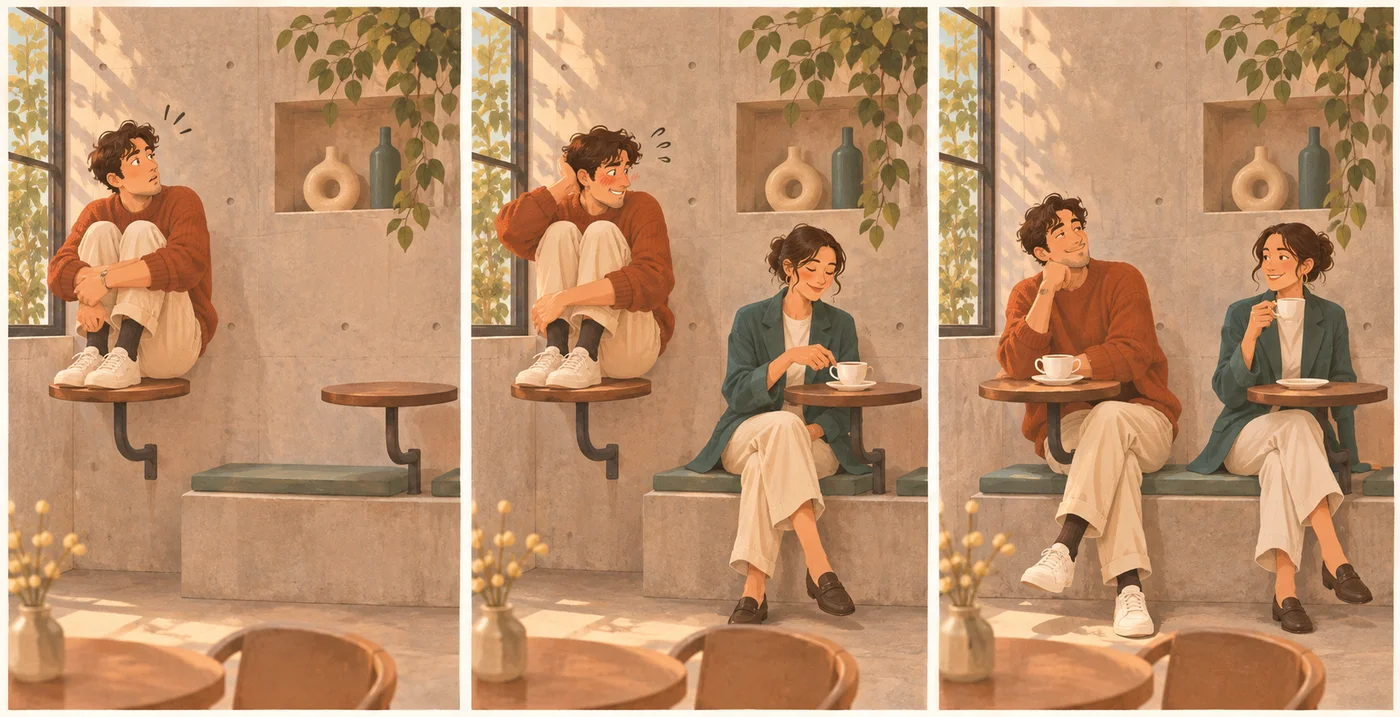
AI-generated storyboard illustrating the joke, not a screenshot or a sample result from the video generator.
You can read a version through three questions:
| Story beat | What the viewer needs to see | What makes the beat confusing |
|---|---|---|
| The mistake | The first customer's body is on the tabletop, with a separate bench below | A close crop hides which surface supports the person |
| The discovery | The arriving customer sits on the bench and uses a table for the cup | The cup and furniture overlap so much that their uses stay unclear |
| The recovery | The first customer notices and changes position | The seat switch happens before the demonstration |
This is why a clear wide shot often serves the joke better than a sequence of dramatic close-ups. The viewer can compare the two customers in the same space. A silent glance can carry the realization once the geometry is readable.
When did the fancy cafe meme appear?
Posts from early November 2026 document the format circulating on TikTok and Instagram. One dated example is Steven Wommack's TikTok post; another is Lee Houston's concrete-cafe version. The site's trend timeline links these examples and a Kevin Winnik version.
Treat those as examples of the format, rather than proof that one account invented it. At our November 4 check, Know Your Meme's entry attributed the original to Lee Houston on November 1, while FADEO's background section described Steven Wommack's same-day post as the earliest version it found. Those are different attribution claims. We have not established the first creator.
View counts also change, so they are less useful here than the actual sequence of actions. You do not need a particular account's popularity numbers to understand or recreate the visual setup.
Why does it work with different people?
The roles matter more than the characters' names. One person confidently misunderstands the setting; the other accidentally supplies the correction. That lets a remake carry a small story about the pair you choose.
For friends, cast the person who tends to improvise as the first customer. For a couple, decide who would notice the mistake and try to hide it. The arriving person does not need a big reaction: behaving normally is what exposes the error.
Keep the first customer's embarrassment gentle. A short pause and a restrained glance leave room for the audience to recognize the situation. Adding a long speech or several new accidents can bury the simple reveal.
These are creative choices for a remake. They are not claims about a particular generator's ability to reproduce an expression or gesture exactly.
What changes when you make it with AI?
An AI template uses your images as character references and supplies a scene around them. The source photos are not footage of the people performing the action. Faces, clothes, hands and furniture can change during the generated movement, so review the whole result.
On Fancy Cafe AI, the current preset takes two separate photos. Person 1 starts on the left; Person 2 enters from the right. The output is a 15-second, 720p vertical video, and a generation uses 500 credits. Those are this site's settings, not universal specifications for the meme or other templates.
The two-photo creation guide covers input preparation, role assignment and downloading. If you are building a variation with a prompt-capable video tool, the cafe prompt and continuity guide explains how to keep the discovery in the right order.
Choose a caption that leaves the reveal visible
A caption only needs to establish unfamiliarity with the place. For example:
- “First visit. Confidently picked my seat.”
- “I understood the menu better than the furniture.”
- “Just waiting for everyone to forget that happened.”
Place text where it does not cover the tabletop, bench or faces. Preview the post with the platform's own buttons and caption area visible; a clean exported file can still become hard to read inside the feed.
Watch once without sound. If the mistaken seat, the demonstration and the recovery still make sense, the scene has a strong visual foundation. Then check the audio and final framing before sharing.
Product settings and linked source pages checked November 4, 2026. Published by Fancy Cafe AI.